Send the exact assignment or rubric from your classroom and a custom sample written to it lands in 24 to 48 hours, the first one free. NU300 is Purdue Global’s Professional Leadership Transitions course. It centers on the working RN's shift into BSN-level professional identity, with leadership language and goal setting that frame the rest of the program. Searches like "NU 300 unit 4 assignment example", "NU300 sample paper", and "NU300 unit samples" land on this page.
What NU300 is really about
NU300 is usually the first course working RNs meet after enrolling in Purdue Global's RN-to-BSN track, and it sets the tone for the 10-week term rhythm the rest of the program follows. Most sections run on the standard cadence: a discussion board in every unit, a live seminar with an alternative assignment option, and written assignments that grow from short reflections into a full professional transition paper. The content itself is familiar territory handled at a new altitude. You already know what an RN does all day; NU300 asks you to describe that work through nursing theory, leadership styles, and professional standards, in third-person academic prose with sources attached.
The early units typically move through nursing theory, the value of BSN education, and leadership self-assessment, while the back half of the term turns toward professional organizations, ethics, and a goals-based plan for your own career. None of it is clinically hard; almost all of it is rhetorically new. Students who have not written academically in years suddenly owe APA-formatted posts, reflective papers that still cite literature, and a seminar schedule that competes with twelve-hour shifts. Our NU300 samples exist for exactly that gap. Each one models how a practicing nurse's experience becomes graded academic writing, matched to the actual assignment instructions and rubric a student sends us.
What NU300’s assessments ask for
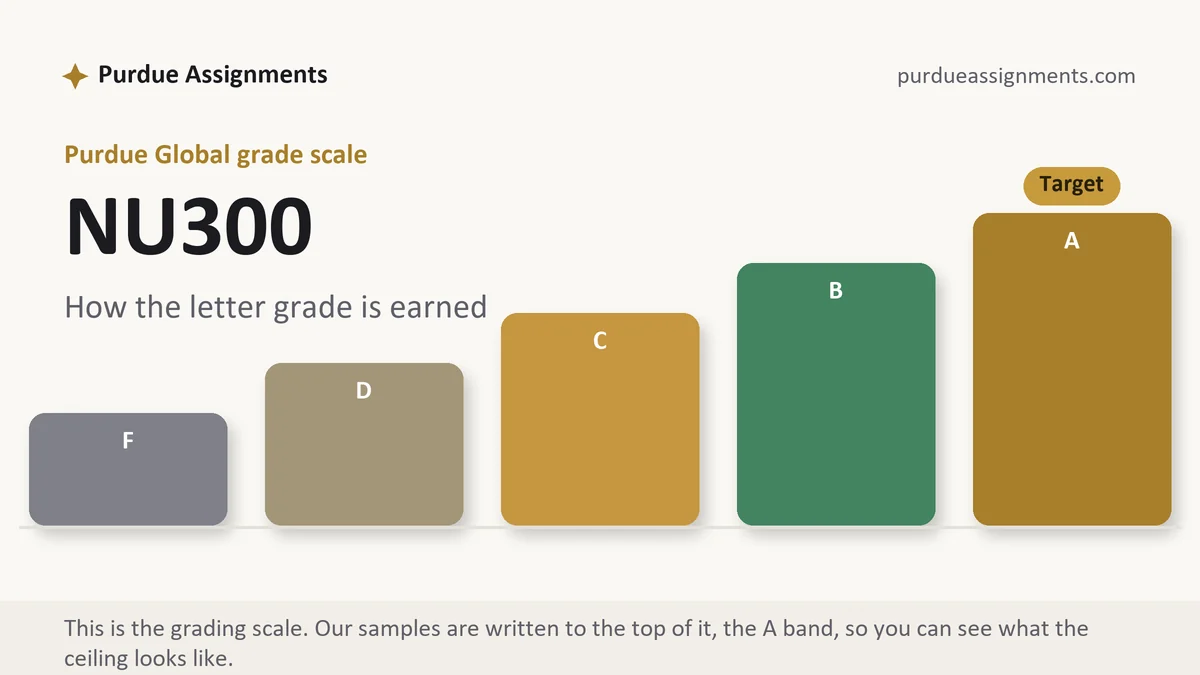
Expect a steady weekly load rather than one giant deliverable. In most sections every unit opens a discussion board that wants an initial post with at least one scholarly source plus substantive replies, and each unit's seminar offers a live session or an alternative assignment, typically a recap or reflection with its own rubric line. The written assignments usually build in sequence: a philosophy or identity piece early, a leadership style analysis mid-term, then a professional goals or transition paper late in the term. Grading runs on points that roll up into a letter grade, and rubrics reward structure, APA mechanics, and evidence as much as content. The course also expects you to connect ANA standards and at least one nursing theorist to your own practice.
Where students lose points in NU300
Two habits quietly drain points in NU300, and both look harmless from inside a busy work week. The first is treating the seminar's alternative assignment as optional. Plenty of students assume that missing the live session simply forfeits a little participation credit; in most sections the alternative is a real graded assignment with its own rubric, and skipping it unit after unit costs more points than anyone expects. The second is posting to the discussion board from experience alone. A confident paragraph about your own floor reads well but earns partial credit when no cited source appears, because the rubric line for evidence scores exactly that. Ten units of uncited posts is a quiet, steady leak on the letter grade.
The NU300 drawers
NU300 Unit 1 professional identity post example
Unit 1 typically opens with introductions, a professional identity discussion board, and the first seminar. On request, free, 24-48h.
NU300 Unit 2 nursing theory application example
Unit 2 often turns to nursing theory and how a chosen theorist shapes daily practice. On request, free, 24-48h.
NU300 Unit 3 role comparison paper example
Unit 3 in many sections weighs BSN education outcomes against your current RN role. On request, free, 24-48h.
NU300 Unit 4 leadership style self-assessment example
Unit 4 often brings a leadership style self-assessment with a short reflective write-up. On request, free, 24-48h.
NU300 Unit 5 professional organization analysis example
Unit 5 frequently examines professional organizations and the case for joining one. On request, free, 24-48h.
NU300 Unit 6 ethics and scope discussion example
Unit 6 often takes up ethics, scope of practice, and a values-centered discussion board. On request, free, 24-48h.
NU300 Unit 7 evidence basics exercise example
Unit 7 in many sections introduces evidence basics that later courses expand fully. On request, free, 24-48h.
NU300 Unit 8 career development plan example
Unit 8 often drafts professional goals, sometimes framed as a career development plan. On request, free, 24-48h.
NU300 Unit 9 transition paper example
Unit 9 typically polishes the final transition paper while seminar reflections wind down. On request, free, 24-48h.
NU300 Unit 10 summative reflection example
Unit 10 usually closes with a summative reflection tying identity, goals, and leadership together. On request, free, 24-48h.
Your classroom shows something else?
Purdue Global revises courses; unit counts and deliverables shift between terms. Send what your classroom shows and the desk matches it exactly.
Using a NU300 sample the right way
Send us the assignment instructions and rubric for whichever NU300 piece is in front of you, and we return a custom sample written to those exact documents, free the first time, in 24-48h. Working RNs use these samples three ways: as a structural map before drafting, as a model of how personal practice stories get cited support, and as a check that a finished draft actually answers the rubric. The sample is a reference document, not something to submit; the words you turn in stay your own. Most students start with a discussion board or seminar alternative, then request the bigger transition paper once the term picks up speed.
How these samples are written
Method, in one line: rubric first, structure from the rubric, evidence current, format exact. Discussion samples read like real posts; unit assignments arrive in submission form. Your free request is drafted against what your classroom actually shows.
NU300 questions, answered
I missed a live seminar in NU300. Is the alternative assignment actually optional?
Treat it as required. In most sections the alternative assignment stands in for the live session and is graded with its own rubric and points, not offered as a courtesy. Skipping it because the seminar felt skippable is one of the most common point leaks in this course. If you are unsure what yours wants, send the instructions and we will draft a free sample version in 24-48h.
Do NU300 discussion board posts really need a cited source if I am writing about my own experience?
Yes. Your experience supplies the example, but the rubric almost always carries an evidence line that a personal story alone cannot satisfy. The pattern that scores well pairs one practice observation with one scholarly source that frames it. Our NU300 samples show that pairing in action, so you can see where the citation sits inside a conversational post.
What counts as a scholarly source for these transitions discussion boards?
Peer-reviewed nursing journals, your assigned readings, and professional standards documents such as ANA publications all work in most sections; blogs and general websites usually do not. The safer habit is one journal article per initial post, cited in APA. If finding sources is the bottleneck, request a free sample post for your exact prompt and we will show a workable source paired with it, within 24-48h.